The Dark Side of Timeshare Rentals
Posted August 13th, 2025
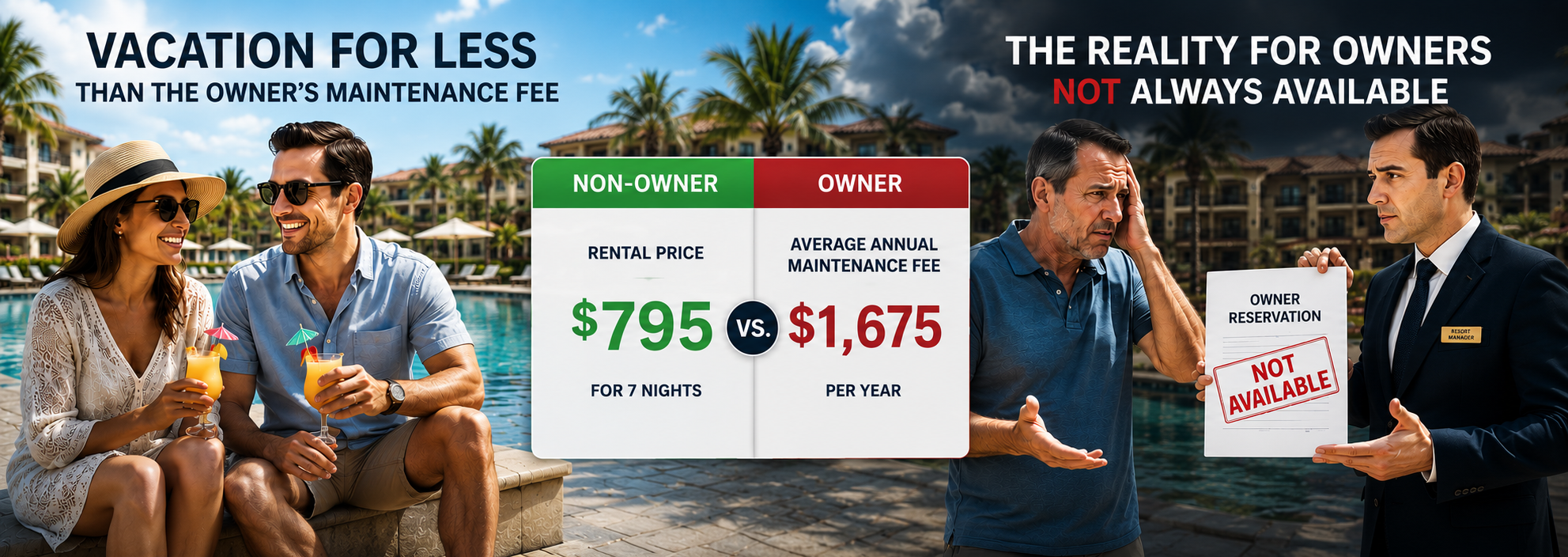
Starting on a positive note, for non members/owners to be able to rent accommodations in timeshare resorts gives them the opportunity to sample the quality afforded by most timeshare resorts. Another positive is that the cost for these holidays is often close to, or even lower than the current maintenance fees paid by owners.
On the darker side, those who vacation at timeshare resorts often find themselves exposed to the business hungry resort sales teams hoping to turn what is a short stay into a long term timeshare purchase.
All this said, this is not the dark side we refer to; we need to look at the impact on owners.
The Impact
A few weeks ago TCA published an article citing various points taken from the latest American Resort Development Association (ARDA) report on the state of the American timeshare industry. In the report it stated that timeshare rental revenues more than doubled from $1.3 billion in 2020 to $3.2 billion in 2024. That’s a 146% increase in RENTAL revenues in just five years!
Let’s take a few points, timeshare owners have paid a significant amount to buy their timeshare, they also pay an ever increasing annual maintenance fee, which according to ARDA is now approaching $1,600 on average. Given that the single largest complaint levelled at timeshare ownership by owners is the everlasting lack of availability, how can developers rent out so much inventory at the expense of owners?
Simple Math proves the point, so let’s play with the numbers. Let’s say that each non owner pays the exact owner’s maintenance fee for their vacation, $1,600. When divided into $3.2bn, this means 2,000,000 non owners had vacations in timeshare resorts.
If 2 million public renters are all vying for the same prime dates, along with owners, it becomes easy to see why there are availability issues. Something has to give.
Vacation rentals for thought
If you own a business, any business then the primary object is to make a profit, nothing wrong with that, however it’s the way you go about making profit that needs scrutiny.
Developers may argue in reverse and state that rentals cross subsidise maintenance fees, that being the case, according to ARDA’s own data, maintenance fees increased 34% in the last five years, from $1,120 in 2020 to $1,490 in 2024. But overall inflation was only 21% during the same period. Timeshare maintenance fees increased 50% faster than inflation! So much for rental cross subsidy. Surely if the cross subsidy benefited timeshare owners, then maintenance fees shouldn’t have risen as much as they have.
The once primary reason for owning a timeshare, being exclusivity has long disappeared into the distance. Timeshare resorts are in general some of the nicest places to take a holiday so it’s no surprise that so many people want to book vacations at them. Bookings made via online platforms and with developers directly seem to indicate that no matter when and where those bookings want to go, there always seems to be availability, unfortunately, the same cannot be said for the faithful paying timeshare owner.
Timeshare developers now seem to have two geese that lay golden eggs, the timeshare owner and the renter, the difference is, one lays golden eggs because they want to, the other is more akin to a battery farm, laying eggs on demand. Is all this fair? We will leave this to you to fathom.
“The timeshare industry continues to evolve, and staying informed has never been more important. We remain committed to delivering trusted information, legal developments, and educational content that helps owners navigate ownership with greater clarity and confidence.” – The Timeshare Blog

 The Timeshare Blog